Abstract:If you've spent any time researching forex brokers, you've almost certainly run into the labels ECN and STP. They sound technical, broker marketing departments use them interchangeably, and the actual difference matters more for your trading costs than most beginners realize.
Both ECN and STP are No Dealing Desk (NDD) execution models — neither broker type takes the opposite side of your trade. That alone separates them from market makers and matters because it removes a fundamental conflict of interest. But the way each model routes your order, prices it, and earns revenue is structurally different, and those differences directly translate into the spread you pay, the slippage you absorb, and whether your strategy is profitable at scale.
This guide breaks down exactly how the two models work, where they diverge, and which one fits which type of trader.
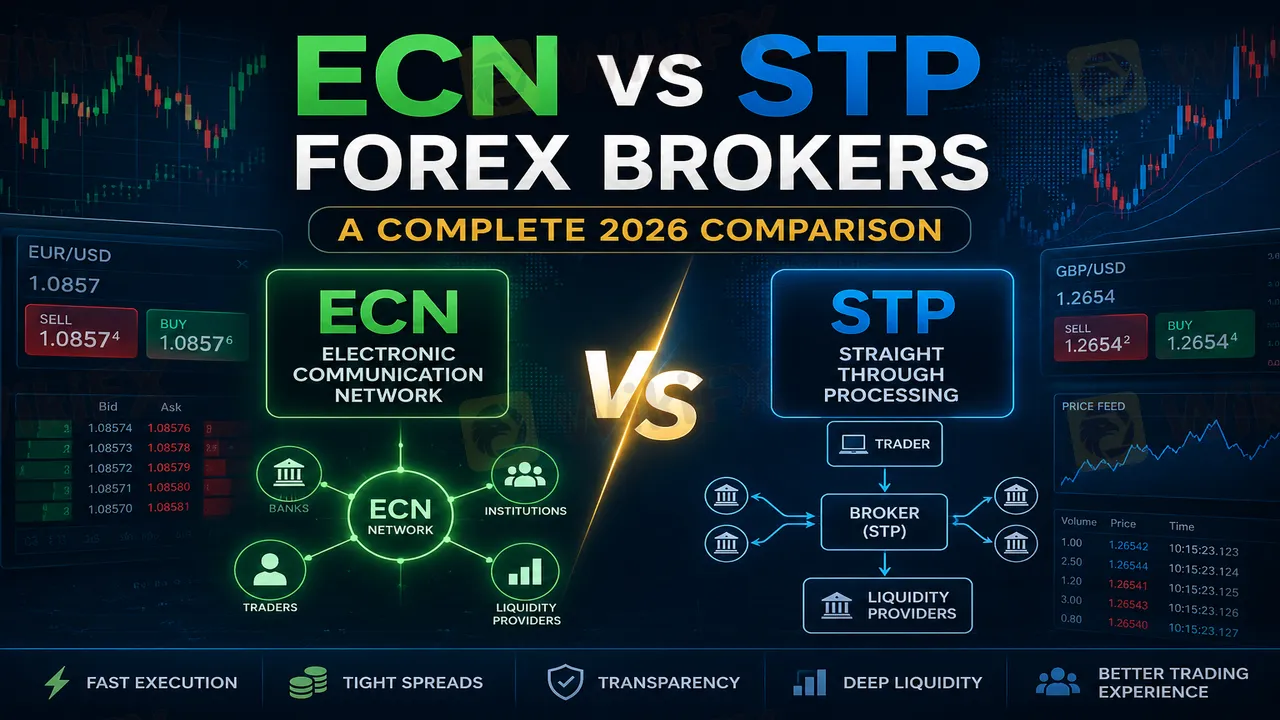
If you've spent any time researching forex brokers, you've almost certainly run into the labels ECN and STP. They sound technical, broker marketing departments use them interchangeably, and the actual difference matters more for your trading costs than most beginners realize.
Both ECN and STP are No Dealing Desk (NDD) execution models — neither broker type takes the opposite side of your trade. That alone separates them from market makers and matters because it removes a fundamental conflict of interest. But the way each model routes your order, prices it, and earns revenue is structurally different, and those differences directly translate into the spread you pay, the slippage you absorb, and whether your strategy is profitable at scale.
This guide breaks down exactly how the two models work, where they diverge, and which one fits which type of trader.
The Bigger Picture: Dealing Desk vs No Dealing Desk
Before comparing ECN and STP, it helps to know the broader landscape. Retail forex brokers fall into two camps:
- Dealing Desk (DD) / Market Maker brokers — The broker creates a private market for its clients, often taking the opposite side of trades and earning from client losses plus a fixed spread. Quotes can be artificial, and re-quotes are common.
- No Dealing Desk (NDD) brokers — The broker routes orders to external liquidity providers rather than internalizing them. There is no dealing desk taking discretionary positions against clients.
ECN and STP are both NDD models. The distinction between them is essentially how and to whom your order is routed once it leaves your platform.
What Is an STP Broker?
STP stands for Straight-Through Processing. As the name implies, the broker passes your order straight through to its pool of liquidity providers — banks, hedge funds, prime brokers, and sometimes even other brokers — with no manual dealing-desk intervention.
The broker's job is to:
- Aggregate live quotes from multiple liquidity providers (LPs).
- Show you the best available bid/ask.
- Route your order to the LP offering that best price.
How STP brokers make money
STP brokers earn revenue mainly by adding a small markup to the raw spread they receive from their LPs. The client sees one all-in bid/ask price with no separate commission line. Some STP brokers also charge a small commission, but the spread markup is the dominant model.
This pricing simplicity — one number instead of “raw spread plus commission” — is part of why STP dominates the retail-facing forex market, especially in emerging economies and on MetaTrader-based platforms.
STP characteristics
- Spreads: Variable, typically 0.6–1.5 pips on EUR/USD, sometimes fixed
- Commission: Usually zero (revenue baked into spread)
- Order routing: To the broker's curated LP pool
- Market depth: Best price only; no Level II order book by default
- Minimum deposit: Usually USD 50–500
- Best for: Retail traders, beginners, traders running under 15–20 lots per month
A trade-off worth flagging: because STP brokers route to a curated pool, the speed and quality of execution depend on which LP wins the order and how that LP's session is performing. In quiet markets, execution is fast and clean. During major news events, some LPs reject orders or widen quotes, and the routing path becomes less predictable.
What Is an ECN Broker?
ECN stands for Electronic Communication Network. Instead of routing orders to a curated pool of liquidity providers, an ECN broker plugs you into a shared electronic network where many participants — Tier-1 banks, non-bank market makers, hedge funds, and even other ECN traders — post buy and sell quotes simultaneously.
Your order is matched anonymously against the best opposing quote in that network. The broker never takes the other side and never adds a markup to the spread.
How ECN brokers make money
ECN brokers earn revenue exclusively through a transparent per-lot commission, typically USD 3–7 round-turn per standard lot. The spread you see is the raw interbank spread — frequently 0.0 to 0.2 pips on EUR/USD during peak liquidity. The all-in cost is the raw spread plus the commission.
This structure means the broker's interests are aligned with yours: they earn the same commission whether you win or lose, so they want you to trade often and trade for a long time.
ECN characteristics
- Spreads: Raw, often 0.0–0.2 pips on majors during peak liquidity
- Commission: USD 3–7 round-turn per standard lot (transparent line item)
- Order routing: To a competitive multilateral network
- Market depth: Full Level II order book typically visible
- Minimum deposit: USD 0–500 at retail level; USD 1,000–20,000+ for institutional tiers
- Best for: Scalpers, high-frequency traders, algorithmic systems, anyone trading 20+ lots per month
ECN also brings something STP usually doesn't: Depth of Market (DOM). You can see not just the best bid and ask but how much volume is sitting at each price level. For scalpers and algo traders, that information is genuinely useful. For everyone else, it's a curiosity.
ECN vs STP: Side-by-Side
The Five Decisions That Should Drive Your Choice
How much volume do you trade?
This is the single most predictive factor. Run the math on your typical month.
On EUR/USD, an ECN account might give you a 0.1-pip spread plus a USD 7 round-turn commission — about USD 8 total per standard lot. An STP account might give you a 1.0-pip spread with no commission — about USD 10 total per standard lot.
The ECN saves USD 2 per lot. Trade 5 lots a month and the savings are trivial. Trade 50 lots a month and you save USD 100. Trade 500 lots a month and you save USD 1,000. The break-even point for most retail traders is somewhere around 15–20 lots per month. Below that, STP is usually cheaper and simpler. Above it, ECN almost always wins.
What's your strategy?
- Scalping and high-frequency trading need the tightest possible spreads and minimal slippage. ECN is the natural fit. The commission cost is a fixed friction you can model. Wide STP spreads will erode small-pip profit targets faster than commissions.
- Day trading can go either way, but most committed day traders eventually migrate to ECN once volume picks up.
- Swing and position trading holds positions for days or weeks, so a half-pip difference at entry matters less than swap rates and platform reliability. STP is usually fine.
- Algorithmic / EA trading generally favors ECN because execution speed and depth-of-market data feed into the algorithm's decisions.
How much pricing transparency do you want?
ECN shows you the raw spread, the commission, and (usually) the full order book. You know exactly what each trade costs and what's behind the quote.
STP shows you a single bid/ask number with the broker's markup invisibly baked in. There's nothing dishonest about that — the broker has to make money somehow — but if you want to verify execution quality against interbank rates, ECN gives you the data and STP doesn't.
Can you handle commission complexity?
Some traders psychologically dislike commission charges, even when the all-in cost is lower. If you'd rather see one number on every trade and not maintain a mental ledger of “spread cost plus commission cost,” STP fits how you think.
That's not irrational. Decision fatigue is real, and a model that lets you focus on the trade itself rather than the cost structure has value. Just be aware that for high volume, you're paying a premium for simplicity.
What's your account size?
ECN minimum lot sizes are typically 0.1 lots (10,000 units), because most ECN liquidity providers don't accept smaller orders. STP brokers can route micro-lots (0.01, or 1,000 units) without issue.
If you're starting with USD 100 or USD 500, you need micro-lots to manage risk properly. That essentially forces an STP account. Once your account is large enough to size positions in 0.1-lot increments without overleveraging, ECN becomes viable.
The Hybrid Reality
In 2026, the cleanest ECN-vs-STP distinction has blurred. Many large brokers — IC Markets, Pepperstone, FP Markets, and others — operate hybrid models where standard retail accounts run on STP routing and “Raw Spread” or “Razor” accounts run on ECN-style execution.
This isn't a marketing trick; it reflects an operational reality. The infrastructure required to run a true ECN — direct Tier-1 LP connectivity, hardware-accelerated matching engines, sub-millisecond latency, full DOM display — is expensive. Smaller brokers and emerging-market platforms often run STP, which is faster to deploy and supports broader account types and smaller trade sizes. Larger brokers run both and let you choose at account opening.
A practical consequence: when a broker advertises “ECN spreads from 0.0 pips,” check the account type and commission structure carefully. The label “ECN” on a marketing page sometimes describes an STP execution with tight spreads, not a true ECN network connection. The honest tells are: a transparent commission per lot, visible Level II order book, and disclosed liquidity provider relationships.
Common Misconceptions
“ECN is always cheaper.” Not below 15–20 lots per month. At low volume, STP's no-commission model usually beats ECN's raw spread plus commission.
“STP brokers can trade against you.” Pure STP routes orders externally. However, some brokers labeled STP actually run a hybrid where smaller orders are internalized (B-Book) and larger orders are externalized (A-Book). The risk isn't STP itself; it's misrepresentation by brokers using the label loosely.
“ECN has no slippage.” ECN reduces dealer-induced slippage to zero, but market slippage — the price moving between order submission and fill during volatile conditions — still happens on any model. ECN also doesn't re-quote, so the trade either fills at the best available price or doesn't fill at all.
“More liquidity providers = better execution.” Up to a point. Adding noisy or aggressive last-look LPs to an STP pool can actually worsen rejection rates and fill quality. Depth and quality of LPs matter more than raw count.
How to Verify a Broker's Execution Model
Marketing copy isn't enough. Before you commit capital:
- Read the legal entity's regulatory disclosures. Real ECN brokers usually disclose their LP relationships and execution policy. Tier-1 regulators like the FCA and ASIC require detailed execution-quality reports.
- Check the commission structure. A genuine ECN account has a transparent, fixed per-lot commission. An STP account dressed as ECN typically has slightly wider spreads and no commission.
- Look at order types and minimum lot size. True ECN often requires 0.1-lot minimum and supports advanced order types (good-till-cancelled, iceberg, etc.).
- Test execution. Open a demo or small live account. Run trades during peak liquidity and during a major news event. Watch the spread behavior, slippage on stop orders, and any re-quotes.
- Ask for execution statistics. Reputable brokers publish average execution speed (sub-100 ms is competitive, sub-40 ms is excellent), positive/negative slippage ratios, and fill rates.
Bottom Line
Neither model is universally better. The right choice depends on volume, strategy, and how much complexity you're willing to manage.
- Choose STP if you're trading under 15–20 lots per month, prefer simple all-in pricing, want micro-lot flexibility, or are still developing your strategy. The lower psychological friction is genuinely valuable in your first one to two years.
- Choose ECN if you scalp, run EAs, trade high volume, want full pricing transparency, or have moved past the “still figuring it out” phase. The cost savings at scale are real and compound quickly.
- Choose a hybrid broker that offers both account types if you want to start on STP and graduate to ECN without changing platforms.
Whichever you pick, the broker's regulator matters more than the execution label. A well-regulated STP broker (FCA, ASIC, CySEC) is almost always a better choice than a poorly regulated broker advertising itself as ECN. Verify the license, read the execution policy, and test before scaling up.
Download the WikiFX app for the latest forex updates.

More Insightful Articles for You
Exposure: Traders Report Account Disablement and Unfair Profit Deductions
review 2026: Reported Legitimate Profit Wipeouts & Withdrawal Delays