


Vietnam Becomes New Base for Cross Border Scam Syndicates After Cambodia Crackdown
Cross border scam syndicates are constantly adapting to evade law enforcement by moving from Cambodia to Vietnam.
Original

简体中文
繁體中文
English
Pусский
日本語
ภาษาไทย
Tiếng Việt
Bahasa Indonesia
Español
हिन्दी
Filippiiniläinen
Français
Deutsch
Português
Türkçe
한국어
العربية
اردو




Abstract:Henry Abdo, founder and CEO of Titanium Capital LLC, recently admitted in U.S. federal court orchestrating an investment fraud scheme that exceeded $6 million. This case exposed a years-long Ponzi scheme involving hundreds of investors.

According to court records, starting in July 2014, Henry Abdo attracted investors to Titanium Capital by falsely claiming that the company operated a sophisticated foreign exchange trading platform capable of providing fixed returns. He marketed Titanium Capital as a “zero-risk” investment fund, stating that profits were generated from foreign currency trading fees. Abdo further deceived investors by claiming that Titanium Capital was part of a multibillion-dollar holding company, developed proprietary trading software, and was registered with the U.S. Securities and Exchange Commission (SEC). Through these carefully crafted false claims, Titanium Capital successfully built a credible financial enterprise image, persuading numerous investors to commit their funds to the platform.
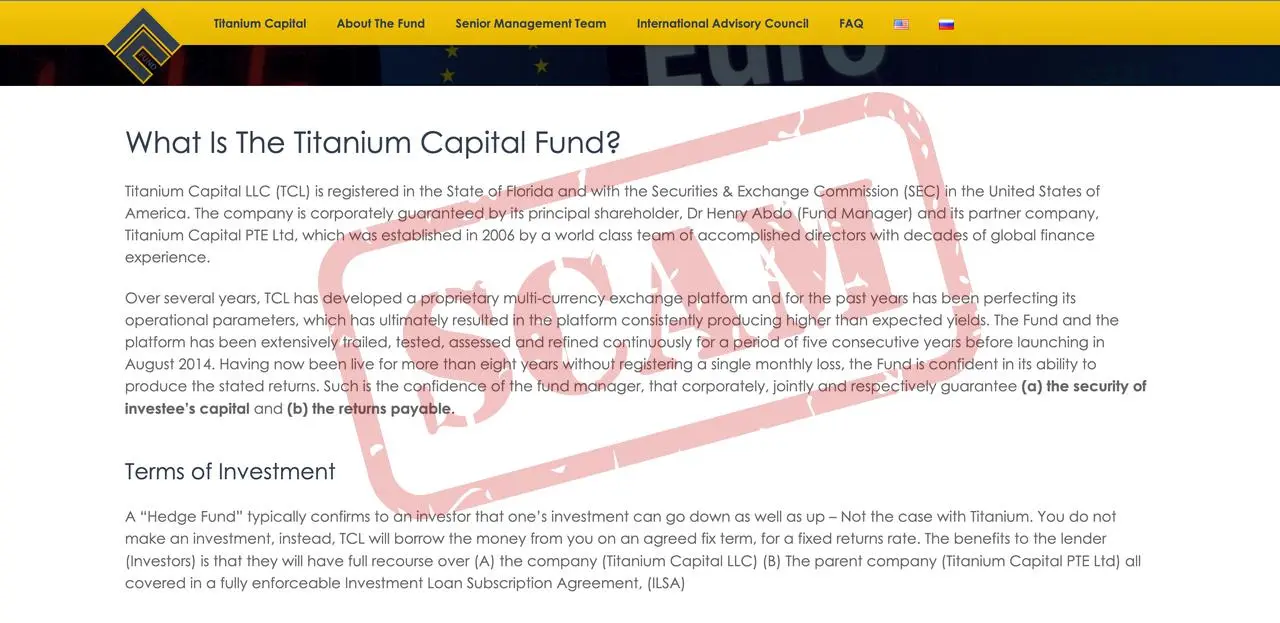
However, in reality, Titanium Capital lacked any legitimate trading capabilities or platforms, and all its promises were fabricated. Abdo used investor funds to pay earlier investors and heavily misappropriated the funds for personal expenses, including luxury goods, international travel, and high-end dining.
Court documents revealed that Abdo used multiple channels to solicit funds, including face-to-face meetings, emails, video conferences, and phone calls. To further broaden the scope of the fraud, he directed prospective investors to a meticulously designed website and promotional materials. These materials portrayed Titanium Capital as a legitimate and efficient investment firm, including examples of real-time account growth and false success stories. All these efforts aimed to build investor trust while concealing the Ponzi scheme operations. Titanium Capitals operation relied on using new investor funds to pay returns to earlier investors, creating the illusion of profitability.
During its operation, Titanium Capital raised millions of dollars from over 200 investors. These investors came from diverse backgrounds, many of whom suffered severe financial losses.

On January 13, 2025, during a U.S. district court hearing, Henry Abdo pleaded guilty to wire fraud. This charge violates Title 18, Section 1343 of the United States Code, and he could face up to 20 years in prison. The specific sentence will be determined after the court considers federal sentencing guidelines and other statutory factors. This ruling is expected to serve as a warning for similar fraudulent activities in the future and to provide a degree of financial restitution to the victims.
This case highlights the prevalence of fraud in the financial investment sector, particularly when digital marketing channels and promises of high returns are involved. It underscores the importance of vigilance among investors when choosing investment platforms, especially when confronted with “zero-risk” or “high-return” claims. Investors are urged to conduct thorough due diligence and verify the legitimacy and operational capacity of such platforms. Financial regulators and judicial authorities will continue to strengthen enforcement to protect investor rights and combat such fraudulent schemes.
Disclaimer:
The views in this article only represent the author's personal views, and do not constitute investment advice on this platform. This platform does not guarantee the accuracy, completeness and timeliness of the information in the article, and will not be liable for any loss caused by the use of or reliance on the information in the article.

Cross border scam syndicates are constantly adapting to evade law enforcement by moving from Cambodia to Vietnam.

Singapore authorities have concluded a major anti-scam enforcement operation that resulted in 221 individuals being placed under investigation for their alleged roles in a wide range of fraudulent schemes.

Malaysia may be emerging as a new destination for transnational scam syndicates seeking to evade mounting pressure from international law enforcement agencies, according to a leading humanitarian organisation.

He Claimed Elite Connections. She Ended Up Losing Millions and Her Dream Car
WikiFXWikiFXWikiFXWikiFXWikiFXWikiFXWikiFXWikiFXWikiFXWikiFX